

Deciding how you want to upgrade a commercial space’s lighting systems can be a challenge. Even more so when you are looking to maintain the historical significance of a period property. How can you bring an old property to modern standards while preserving its unique features? Or update a workplace with minimal disruption to workflow? One way is to use refurbished lighting fixtures rather than replace them. Although this process is accessible, cost-effective and sustainable, not all fixtures are suitable for refurbishment. For this reason, DRK Lighting conducts a full, free site inspection and validation process for every proposed project to maximise the likelihood of a successful outcome. This comprehensive process is as follows:
1) Initial Contact & Information Gathering
Every refurbished lighting project begins with a detailed conversation. During this initial contact, we work with the client to understand the scale and scope of the site: How many fittings are present? What types, sizes, and ages are we dealing with? If OEM manuals or technical documents for the existing fittings are available, they are extremely valuable at this stage. They allow us to confirm material compositions, weights, and original light outputs before we ever set foot on site. Gathering this information early helps us anticipate what can be reused, what needs replacing, and how we can maximise environmental savings throughout the project.
2) On-Site Visual & Structural Audit
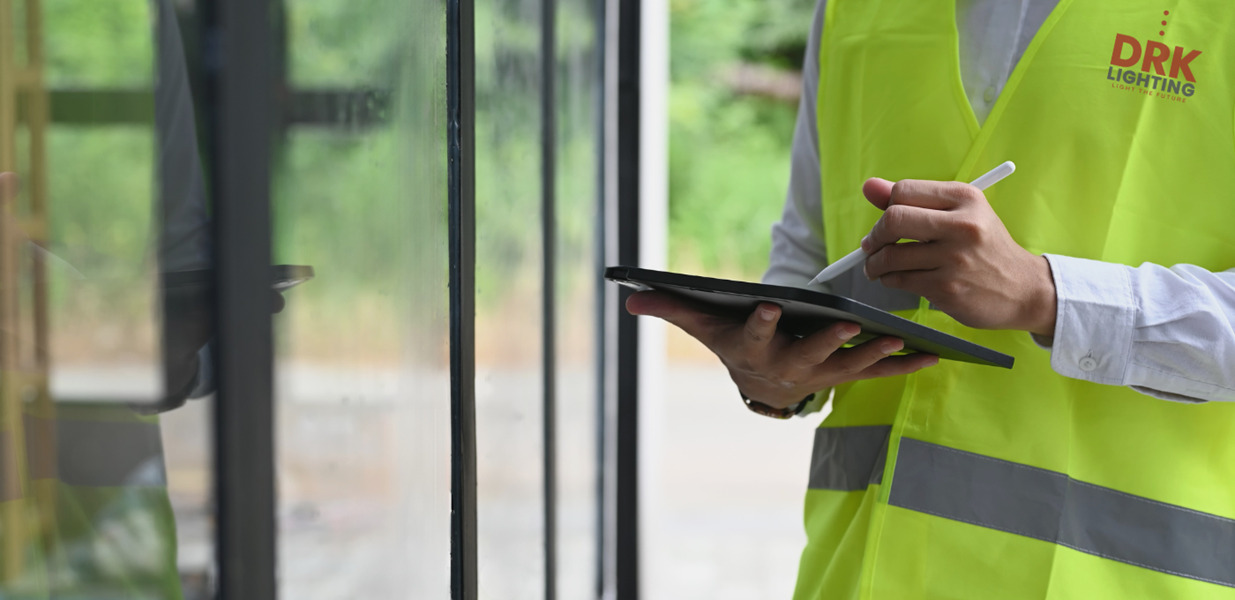
Next, our team conducts a thorough on-site audit. This is where we assess the physical condition of the fittings, the structural environment, installation methods, and any constraints that might affect remanufacturing options. We use a dedicated software, Site Audit Pro, on an iPad to document every fitting with photos, notes, and measurements. This allows us to build a comprehensive digital report, giving both our engineers and the client full clarity on the existing lighting landscape before we begin any hands-on work.
3) Sample Fitting Assessment & Technical Testing
Once the audit is complete, we take a representative sample fitting back to our workshop. Here, we disassemble it to determine exactly which components can be kept, refurbished, recycled, or need to be replaced. In cases where fittings are plastered-in or otherwise impossible to remove without damage, our engineers create a precise, working replica so we can still run all necessary tests.
From there, we carry out EMC (Electromagnetic Compatibility) testing to ensure that the remanufactured luminaire will meet modern compliance standards. We also generate an LDT file for lighting design calculations to verify that the updated fitting will meet required lighting outputs. This ensures that remanufacturing doesn’t just reduce environmental impact, it also guarantees performance equal to or better than the original design.
4) Energy & CO₂ Savings Calculations
With technical data collated, we calculate the projected energy and carbon savings that the refurbished lighting system will deliver. This includes comparing the original wattage and performance of the existing fittings with the upgraded specifications. These calculations help clients understand both the immediate efficiency gains and the long-term environmental benefits, making the sustainability value of remanufacturing clear and measurable.
5) Determining the Best Remanufacturing Method: In-Situ or Off-Site
Finally, we decide where the remanufacturing work will take place. Some projects are best served by installing refurbished fittings directly in situ, especially when this avoids removing plastered-in housings or disrupting tenants. In other cases, it is more efficient to remanufacture the units in our own facility, where we can fully rebuild and test the internals before they are reinstalled.
In many situations, we take a hybrid approach, which means pre-building internal components in our workshop and then sending them to site for quick installation. This reduces disruption to occupied floors and significantly cuts transport emissions, further enhancing the project’s sustainability profile.
Conclusion
Our 5-step inspection process ensures customers can proceed with refurbishment or replacement, confident that their decision satisfies their project’s cost, performance and quality parameters.
