

You know what an OEM is. But what about an OER? OER stands for Original Equipment Remanufacturer.
It is still a relatively new term, but it describes an increasingly important capability within the lighting industry, and one that sits at the heart of what we do at DRK Lighting. An Original Equipment Remanufacturer takes existing lighting equipment and engineers it for a second life.
From replacement to remanufacture
Until now, the conventional approach to a lighting upgrade has been to remove the existing luminaires, replace them with new products and dispose of what came out of the building.
Remanufacturing challenges that assumption. As Recolight’s Ray Molony puts it:
“Rather than accepting that a luminaire’s useful life ends when a project is refurbished, remanufacturing asks what can be retained, upgraded and put back into service?”
This question changes how we view existing lighting equipment.
A luminaire is no longer automatically a waste product because its light source, driver, controls or other components have become outdated. The fitting itself may contain significant material, architectural and financial value that can be retained.
The role of the OER is to unlock that value.
What makes an Original Equipment Remanufacturer?
At DRK Lighting, remanufacturing is our speciality. With our dedicated remanufacturing technicians and The White Cube remanufacturing lab, we can assess, disassemble, upgrade, rebuild, and return existing luminaires to service with modern light sources, drivers, controls, and other components.
Crucially, this capability does not have to be limited to products originally manufactured by DRK. It allows us to approach existing lighting equipment as something that can have another lifecycle, rather than something destined for disposal.
Ray Molony describes DRK as “one of a growing number of Original Equipment Remanufacturers, or OERs, in the sector”, adding that seeing businesses make a commercial success of the model is “key to making this a sustainable and thriving sector.”
Remanufacturing as a formal process
For remanufacturing to become a credible alternative to replacement, it cannot only be an informal process of putting new components into an old fitting.
At DRK, our remanufacturing aligns with our BS 8887_220 accreditation, keeping the process streamlined, transparent, and fully documented.
The objective is to give existing equipment a properly engineered second life, extending service life while providing the performance required from a modern lighting installation. DRK also provides a 7-year warranty on our remanufactures and a 20-year duty of care.
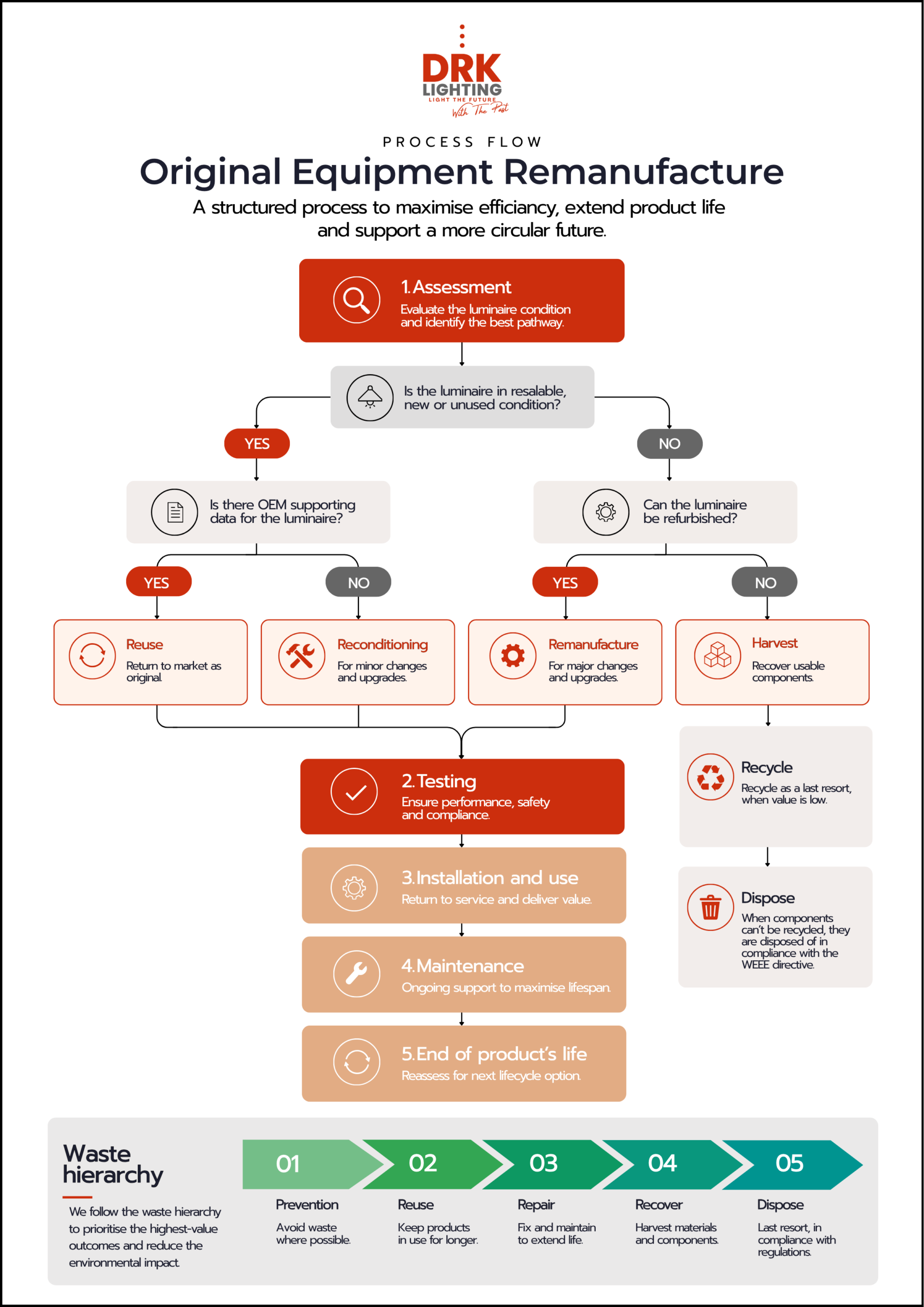
DRK Lighting’s OER Process Flowchart
Why OER matters for the circular economy
The significance of Original Equipment Remanufacturing becomes clearer when you consider the amount of value already installed within our buildings.
Every existing luminaire contains materials that have already been extracted, processed, manufactured, transported and installed. Replacing an entire fitting can mean throwing much of that value away just because one part of the product has become obsolete.
As an OER, we start somewhere different, asking:
What can we keep?
What needs to change?
And how can we engineer this product so that it can perform effectively for another life?
That thinking moves circularity away from being purely a product-design ambition and towards something that can be applied to the enormous installed base of lighting already in our buildings.
Molony captures this principle:
“Circular lighting is not simply about designing better products. It is about finding ways to keep the products we already have in productive use for much longer.”
Benefits to local economy
When discussing remanufacturing, Campaigner Lady Lucy French OBE says:
“Remanufacturing, using a UK labour force, is a win-win for the local economy and the wider issues of our planet’s well-being.’’
This highlights another key advantage of remanufacturing: unlike the production of new equipment, which is often carried out by foreign manufacturers, remanufacturing can be delivered by a skilled local workforce. This means more of the money spent stays in the local economy, supporting local jobs, businesses, and supply chains rather than flowing overseas. As demand for remanufacturing grows, it can also create opportunities for skilled employment in areas such as engineering, inspection, repair, testing, and logistics. In this way, remanufacturing provides benefits beyond reducing waste and extending product life; it can also strengthen local industry, develop technical skills, and contribute to a more resilient local economy.
Preserving more than materials
There is another important benefit. Remanufacturing can preserve the design and architectural identity of a luminaire as well as its physical materials.
That same principle can apply beyond heritage projects.
There are countless buildings containing well-designed, robust luminaires whose housings, optics or architectural form remain perfectly valuable. Their technology may need updating; the product itself does not need replacing.
OER: a term gaining traction
OEM became part of the industry’s vocabulary because it described an important manufacturing capability. OER, Original Equipment Remanufacturer, has a place alongside it.
As the lighting industry moves towards a more circular model, the ability to manufacture new products will remain important. But so will the ability to take responsibility for the products and materials that already exist.
Ray Molony describes remanufacturing as moving “from fringe to the frontline”, with refurbishment and reuse increasingly becoming some of the first options that should be considered when planning a lighting upgrade.
Don’t automatically replace what already exists. First ask whether it can be engineered for another life.
That is Original Equipment Remanufacturing.
